


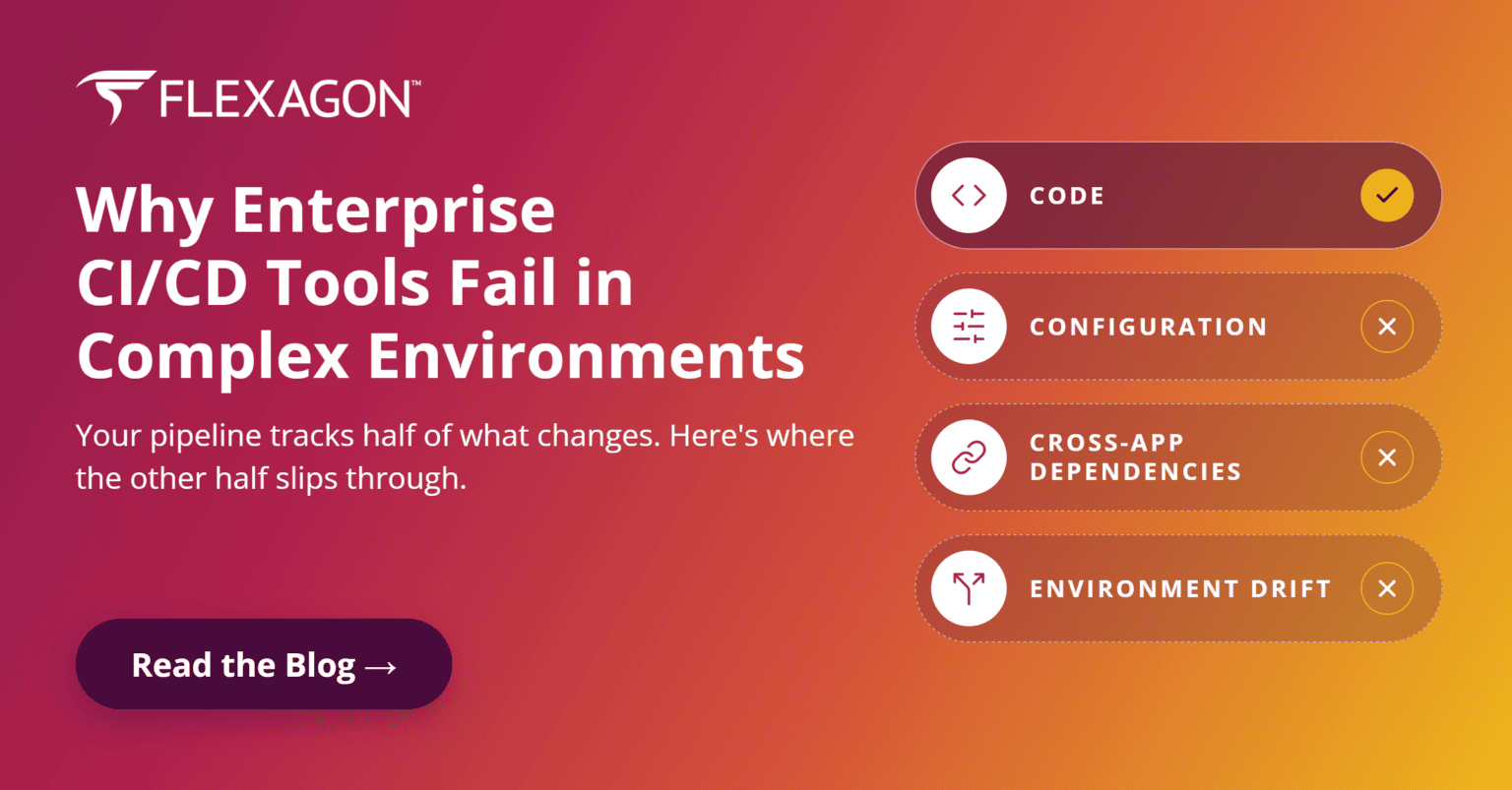
Running a CI/CD pipeline for a single application team is a different problem than governing releases across dozens of enterprise applications. When your environment includes Oracle EBS, Oracle Fusion Cloud, Salesforce, and custom middleware, the points of failure multiply in ways that generic CI/CD tools are not built to handle.
Flexagon gives you a single governed pipeline for both code and configuration changes across these complex environments. This article identifies the most common warning signs and root causes behind enterprise CI/CD breakdowns, with concrete lessons your release and compliance teams can act on.
Key Takeaways: Enterprise CI/CD Pipeline Failures
- Enterprise CI/CD pipelines break when they govern code deployments but leave configuration changes entirely untracked.
- Approval gates that lack work item traceability create audit exposure and regulatory risk for compliance teams.
- Environment drift between dev, test, and production causes unpredictable failures that are difficult to diagnose.
- Flexagon unifies release automation and configuration management in one pipeline with a complete audit trail.
- Cross-application dependency failures are among the most overlooked causes of enterprise release delays and rollbacks.
Common Reasons Enterprise CI/CD Pipelines Fail
1. Configuration Changes Fall Outside the Pipeline
Most CI/CD platforms govern code but treat functional configuration as a separate concern. Workflow rules, approval limits, business unit assignments, and data structures move between environments through spreadsheets or ad hoc scripts with no configuration management controls.
The result: your pipeline tracks half of what changes. The other half has no audit trail, no rollback path, and no dependency sequencing. When a production incident traces back to a configuration change that bypassed the pipeline, your team spends days reconstructing what happened.
2. Approval Gates Lack Work Item Traceability
Approval gates are standard in most CI/CD platforms. What is not standard is traceability from each gate back to the specific work item or change request that triggered the release. Without that link, your audit trail is incomplete.
If an auditor asks what changed in production last quarter, a gate recording only “approved by user X on date Y” does not answer. Governance requires a traceable connection from each approval to its originating requirement and target environment. The OWASP Top 10 CI/CD Security Risks project lists Insufficient Flow Control Mechanisms and Insufficient Logging and Visibility among its top risks, and both apply when an approval cannot be traced back to the change it authorized.
3. Environment Drift Goes Undetected Between Stages
Configuration drift between dev, staging, and production is not a theoretical risk. It is the root cause of a category of failures where code that passes every test still breaks in production. Your deployment pipeline assumes environments are identical, but no mechanism validates that assumption.
Field-level comparison between environment states, before each promotion, is the operational control that prevents this. Without it, your team diagnoses production issues that originated two environments back. Flexagon Configuration Management addresses this by comparing environments, baselines, and migration plans at the field level, building migration plans from only the differences between source and target, and loading setups through Oracle-supported methods that apply standard application validation. Comparison reports before and after migration confirm the target matches the approved plan.
4. Cross-Application Dependencies Are Not Sequenced
An enterprise on Oracle EBS may also run Oracle Integration, a Salesforce CRM, and custom middleware between them. A release that touches multiple applications requires release orchestration with dependency sequencing, not just parallel pipelines.
When dependencies are not sequenced, a downstream application deploys before an upstream API change completes. The failure does not surface until end users report broken functionality. Flexagon handles multi-application CI/CD orchestration with coordinated pipelines, shared approval gates, and a unified audit trail across all applications in a single release.
5. Post-Refresh Recovery Is Not Automated
Enterprise environments undergo regular refreshes (cloning production data into lower environments for testing). Each refresh overwrites configuration that your team customized in dev or QA. Without automated post-refresh recovery, your team manually reconstructs those customizations every time.
With Flexagon Configuration Management, your team can capture a baseline of lower-environment configuration before a refresh, then restore supported setups through a migration plan built from the differences. The warning sign: if your team maintains a spreadsheet of “things to fix after a refresh,” the process is uncontrolled and the risk of missing a step compounds with every cycle.
6. Pipeline Security Controls Are Bolted On, Not Built In
Adding security scans and compliance checks after the pipeline is already in production creates gaps. Credentials stored in plaintext, overly broad access permissions, and unsigned artifacts all introduce vulnerabilities that a post-hoc security layer does not fully address.
Pipeline security needs to be a native pipeline step, not a gatekeeping layer applied from outside. Role-based access controls, credential vaulting (through systems like HashiCorp Vault or CyberArk), and automated compliance validation should execute as stages in the same pipeline as your build and deploy steps.
7. Governance Processes Produce No Defensible Evidence
Some enterprises run approval workflows that look like governance but generate no evidence an auditor can verify. Gates that are not tied to work items, or audit records that require manual assembly after the fact, do not meet the standard for regulatory compliance.
A system-generated audit trail that captures every approval, every artifact version, every environment promotion, and every linked work item is the baseline for defensible governance. Flexagon generates this trail automatically across both code deployments and configuration migrations, with no separate reconciliation required.
8. Scaling Pipelines Require Custom Scripting for Each Application
When adding a new application to your CI/CD pipeline requires custom scripts and environment-specific configuration from scratch, scaling becomes a bottleneck. Your platform team spends more time maintaining pipeline infrastructure than delivering releases.
Out-of-the-box connectors for enterprise applications (Oracle EBS, Oracle Fusion Cloud, SAP, Salesforce) eliminate the need to script each onboarding from zero. Flexagon’s pre-built connectors and reusable pipeline templates reduce the custom scripting needed to onboard supported application types. This frees your platform team to focus on release governance rather than toolchain maintenance.
How to Build CI/CD Pipelines That Hold Up at Enterprise Scale
The pattern behind most enterprise CI/CD failures is a pipeline that governs code but not configuration, tracks approvals but not traceability, and deploys applications in isolation with no cross-application orchestration. Closing these gaps requires a platform that treats configuration management as a first-class concern alongside release automation.
Flexagon brings both disciplines into one governed pipeline, with approval gates, dependency sequencing, work item linkage, and a complete audit trail across every change and every environment. If your current platform leaves half the job undone, see how Flexagon closes the gap.
FAQs about Why Enterprise CI/CD Tools Fail in Complex Environments
What is the most common cause of enterprise CI/CD pipeline failures?
Configuration changes that fall outside the pipeline are the most frequent root cause. When functional configuration (workflow rules, approval limits, data structures) moves between environments without governance, the result is untracked changes, audit gaps, and production incidents your team cannot trace.
How does configuration drift affect CI/CD reliability?
Configuration drift causes code that passes all tests in staging to fail in production. The environments are no longer identical, and the pipeline has no mechanism to detect the difference. Field-level environment comparison before each promotion prevents this class of failure.
Why do approval gates fail to satisfy auditors?
Approval gates fail audits when they record only the approver and timestamp but lack traceability to the originating work item. Auditors need evidence linking each approval to a specific change request, artifact, and environment. Flexagon automatically generates an audit trail that connects all of these.
What makes cross-application releases difficult to manage?
Cross-application releases fail when dependencies between applications are not sequenced. A downstream system deploys before an upstream API update completes, causing production errors. Multi-application CI/CD orchestration with shared approval gates and coordinated pipelines addresses this directly.
How does post-refresh recovery affect pipeline reliability?
Environment refreshes overwrite customized configurations in dev and QA. Without automated recovery, teams manually rebuild those customizations after each refresh cycle. Flexagon Configuration Management lets teams baseline configuration before a refresh, then restore supported setups through a migration plan built from the differences, instead of rebuilding them by hand.
Can enterprise CI/CD tools govern both code and configuration?
Most CI/CD tools govern code deployments but treat configuration as a separate process. Flexagon unifies both in a single pipeline, applying the same approval gates and audit trail to configuration migrations as to code releases. Migration plans let teams set the order in which setups are loaded, so configuration changes deploy in the right sequence. This eliminates the governance gap that causes many enterprise failures.