


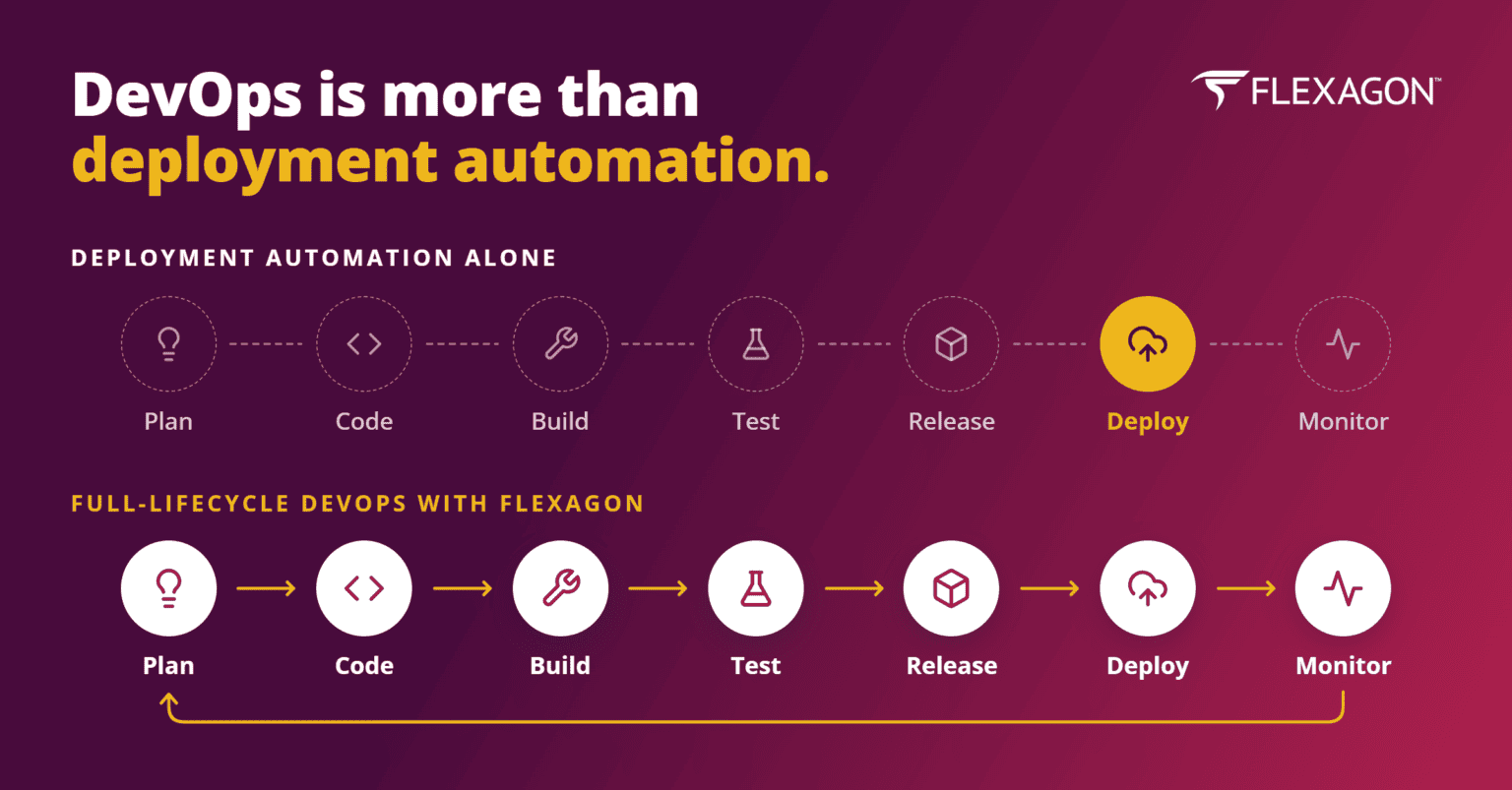
Is deployment automation enough for enterprise DevOps? No. Deployment automation is one step in a much longer chain, and stopping there leaves most of the value of enterprise DevOps switched off. Genuine DevOps spans the full lifecycle, from planning and coding through building, testing, releasing, deploying, and monitoring, and it treats configuration with the same rigor as code.
The pattern we keep seeing
We see a recurring pattern across enterprise teams. An organization adopts a DevOps platform, automates its deployments, and calls the project done. Releases still get coordinated by hand. Pipelines sit unused. The team is genuinely faster at the one step they automated, but most of the platform’s value never gets switched on, usually because the people running the implementation are wary of changing processes they already know.
It is an understandable instinct. Automating deployment is the visible win, the part everyone pictures when they hear “DevOps.” But it is also the easiest part of the lifecycle to automate, which means teams often automate the low-risk step and leave the high-risk work, quality, security, and compliance, entirely manual. That is exactly where errors creep in, and exactly where outages start.
What does DevOps cover?
When most organizations hear “DevOps,” they think of deployment automation: scripts that push code from one environment to the next. That is part of the picture. If it is the whole picture, most of the available value is left on the table.
Real DevOps runs as one continuous, governed loop: plan, code, build, test, release, deploy, and monitor, flowing through test, QA, and production environments and looping back around. Deployment is a single step inside that loop, not the loop itself. And unlike generic DevOps tooling built for custom application code, enterprise environments need this loop to run natively across the platforms they rely on, including Oracle, Salesforce, and SAP.
What goes wrong when only deployment is automated?
Consider what happens when deployment is automated but nothing else is. Handoffs between planning and coding stay manual. Build processes stay inconsistent from team to team. Testing gets bolted on at the end instead of built into the process. And there is little to no visibility into what changed, why it changed, or who approved it.
In effect, the organization automates the easiest part of the lifecycle and leaves the highest-risk parts manual. Faster deployments do not help much when the risk sits upstream of deployment.
How does a full-lifecycle platform close the gap?
Flexagon treats DevOps as a full lifecycle discipline rather than a deployment script. Four capabilities make that possible:
- End-to-end automation. Build, artifact management, and CI connect all the way through to deployment, so teams stop stitching together disconnected tools, each with its own failure points.
- Continuous quality. Issues get identified and addressed as they arise, with actions triggered automatically based on results, instead of surfacing only after code reaches production.
- Embedded security. Integrated security scanning guards against vulnerabilities throughout the pipeline, not just at a final checkpoint before release.
- Governed, repeatable pipelines. Every release follows the same auditable path, giving compliance-heavy organizations the visibility and traceability they need.
This is where the customers in that opening pattern leave value behind. Release orchestration coordinates everything moving through the pipeline from a single point of control, rather than managing releases by hand across disconnected systems. Skip it, and you keep doing manually the exact coordination the platform was built to govern.
The Flexagon DevOps platform supports this full lifecycle natively across Oracle, Salesforce, and SAP, so the same governed approach applies whether a team runs one of those stacks or a blend of all three.
Why does configuration management deserve equal attention?
Configuration management is frequently treated as a lightweight afterthought to code deployment. In practice, it is one of the most nuanced disciplines in enterprise application management. Four factors drive that complexity:
- Volume and change. Configuration settings are exposed to constant change from many sources, and the volume of configuration data can be significant.
- Clarity. The speed and clarity with which a team can access and understand configuration settings is vital to sound decisions.
- Pace. Configurations must change quickly, accurately, and consistently to keep pace with business growth.
- Auditability. Audit and compliance requirements around configuration keep growing, and configuration is often more dynamic than other areas of the application landscape.
Flexagon delivers Configuration Management purpose-built for Oracle Fusion Cloud and E-Business Suite environments. The core value is visibility: clear, targeted insight into configuration settings that lets teams make faster, better decisions, whether they are working proactively or responding to an active issue. Every configuration change runs through a standardized deployment pipeline, providing version independence and the ability to assess the impact of a patch or upgrade before committing to it. Control, governance, and full auditability are built in at every stage.
What is the business impact?
Organizations using Flexagon deliver releases 60% faster, with 5x fewer errors and every release audit-ready.
Those results do not come from a faster deployment script. They come from removing manual work and risk across every stage of the lifecycle: planning, testing, releasing, and monitoring, not just the final mile.
The takeaway
Deployment automation is a necessary building block of enterprise DevOps, but it is not sufficient on its own. Teams that stop at deployment automation leave the highest-risk parts of the lifecycle, quality, security, and configuration, largely manual, and that is where errors, outages, and compliance gaps take root.
The teams getting full value treat enterprise application lifecycle management, DevOps automation, and configuration management as inseparable disciplines on a single, governed platform. That is what turns “we automated deployments” into faster releases, fewer errors, and audit-ready confidence at every stage.
See how Flexagon can help your team move faster and more safely at the same time.