


The short answer: Oracle AI World London 2026 marked a significant shift in Oracle’s AI story — from individual embedded features and assistants to full Fusion Agentic Applications that reason, decide, and act inside business processes autonomously. The operational implications for Oracle teams are substantial, and most enterprises are not yet ready for what Oracle just put on the table.
In this post:
- What Oracle AI World London was and why it matters
- The biggest announcement: Oracle Fusion Agentic Applications
- What Oracle AI Agent Studio can now do
- What we heard on the floor at Booth 51
- What all of this means for Oracle teams operationally
- FAQ: Oracle AI World London 2026
What Oracle AI World London Was and Why It Matters
Oracle AI World London took place on March 24, 2026 at ExCeL London. It was part of Oracle’s global AI World Tour — a series of regional events that replaced Oracle’s traditional Cloud World Tour London format in 2026, signalling how central AI has become to Oracle’s identity and market positioning.
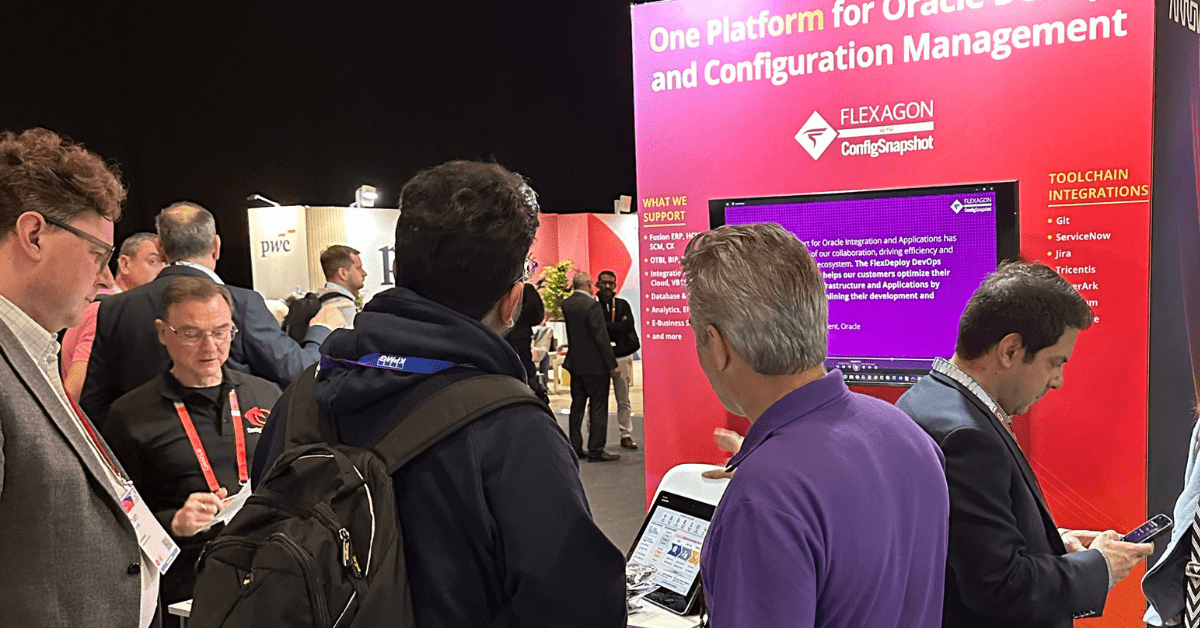
The event brought together Oracle customers, partners, and ecosystem players from across the UK and Europe for a day of keynotes, theatre sessions, hands-on labs, and partner demonstrations. Flexagon was there at Booth 51, talking to Oracle teams about DevOps automation, configuration management powered by ConfigSnapshot, and the operational challenges that come with managing AI-driven change across Fusion Cloud and E-Business Suite.
The headline from the event was clear: Oracle is not positioning AI as a future capability. It is embedding AI directly into the core of how enterprise applications work — and the pace of that embedding is accelerating significantly.
As Oracle CEO Mike Sicilia put it in his opening keynote, AI is like jet engines replacing propellers on planes — enabling whole new capabilities, but only when you rethink the entire system around them. Bolting AI onto old processes will not work. The whole operational model has to be ready for it.
That framing set the tone for everything that followed.
The Biggest Announcement: Oracle Fusion Agentic Applications
The most significant announcement at Oracle AI World London was the introduction of Fusion Agentic Applications — a new class of enterprise applications built into Oracle Fusion Cloud that go significantly further than anything Oracle has previously shipped under the AI banner.
What Fusion Agentic Applications actually are
Fusion Agentic Applications are not AI assistants or copilots that sit alongside existing workflows. They are coordinated teams of specialised AI agents that operate natively inside Oracle Fusion Cloud Applications — able to make and execute decisions within business processes by accessing unified enterprise data, workflows, policies, approval hierarchies, permissions, and transactional context in real time.
As Oracle’s EVP of Applications Development Steve Miranda said at the event, the goal is to move enterprise software beyond passive systems of record into applications that can reason, decide, and act in pursuit of defined business objectives.
The initial release includes 22 Fusion Agentic Applications across finance, HR, supply chain, and customer experience. These include:
- The Cross-Sell Program Workspace for sales teams looking to lower customer acquisition costs and identify growth opportunities
- The Workforce Operations Agentic Application for automating manual HR work
- The Design-to-Source Workspace for coordinating supply chain operations and lowering product cost
- The Collectors Workspace for continuous, intelligent cash flow management in finance
What makes them different from previous Oracle AI
Three things distinguish Fusion Agentic Applications from Oracle’s previous AI releases.
Outcome-driven rather than task-driven. Previous Oracle AI features automated specific tasks. Fusion Agentic Applications operate against defined business objectives and continuously work toward them — reasoning, adjusting, and re-optimising as conditions change rather than stopping after a single action.
Persistent context. The applications maintain shared context across time and steps, so agents can remember intent, prior decisions, and current state without users having to reconstruct information at each interaction. That persistent memory is what allows multi-step, autonomous execution to work reliably inside complex enterprise workflows.
Native governance. Because they are built into Oracle Fusion Cloud rather than bolted on, Fusion Agentic Applications operate within existing role-based access controls, approval hierarchies, and audit frameworks — with end-to-end traceability of decisions and execution paths built in from the start.
That last point matters enormously for Oracle teams thinking about operational readiness. Built-in governance is a significant advantage. But it only holds when the surrounding environment — release processes, configuration management, cross-system dependencies — is controlled and consistent.
When they are available
Fusion Agentic Applications are available now as part of Oracle Fusion Cloud Release 26A — Oracle’s first quarterly update of 2026. They are included in Oracle Fusion Cloud subscriptions at no additional cost.
What Oracle AI Agent Studio Can Now Do
Alongside Fusion Agentic Applications, Oracle announced a significant expansion of Oracle AI Agent Studio for Fusion Applications.
New capabilities in AI Agent Studio
The updated Oracle AI Agent Studio now includes an Agentic Applications Builder — a natural language development environment that allows customers and partners to build, connect, and run AI automation and agentic applications using reusable Oracle, partner, and external agents without traditional application development.
Additional new capabilities include workflow orchestration, content intelligence, contextual memory, ROI measurement tools, and built-in observability and safety controls. The platform now connects to a network of more than 63,000 certified experts trained in Oracle AI Agent Studio, giving Oracle customers access to specialised deployment support across a wide range of industries and use cases.
Customers can use Oracle AI Agent Studio to extend the 22 off-the-shelf Fusion Agentic Applications, or build entirely new ones that integrate within Oracle Fusion Applications in the same way as those built by Oracle itself.
What this means for configuration and change management
Every agent created or customised in Oracle AI Agent Studio represents a change that needs to be managed across Oracle environments. Agents built in Oracle AI Agent Studio operate within existing Fusion security configurations — but those configurations need to be consistent, correctly deployed, and traceable across development, test, and production environments before the agent can operate as intended.
As the number of custom agents grows — and Oracle’s network of 63,000 certified experts will ensure it does — the configuration management and release discipline requirements around those agents will grow with them.
What We Heard on the Floor at Booth 51
Flexagon was exhibiting at Booth 51 at Oracle AI World London, and the conversations we had throughout the day reflected the themes that Oracle’s keynotes introduced — but from the perspective of the people who actually have to manage the operational implications.
Matt Searle, a Flexagon team member and board member of the UK Oracle User Group, attended the event and caught the opening keynote with Steve Miranda alongside a session from KPMG and Seadrill on their move to Fusion Cloud. As someone embedded in the Oracle community through his UKOUG board role, his read on the day is worth sharing.
His overarching observation: “AI is moving from hype to real workflows. The focus has clearly shifted to embedding AI directly into business processes — not just pilots, but production use cases that drive measurable outcomes.”
Several themes stood out across the day.
Data and competitive advantage. There was strong emphasis on unified data platforms — bringing together transactional, analytical, and AI workloads to enable faster, smarter decision-making. For Oracle teams, that means the data flowing through Fusion needs to be accurate, consistent, and governed before AI agents can act on it reliably.
AI agents and automation accelerating. The concept of AI agents taking on more complex, multi-step tasks gained real traction throughout the day — moving beyond simple copilots into true operational automation.
Industry-specific AI as the real differentiator. From financial services to retail and public sector, the message was clear — tailored AI solutions will drive the most impact. Generic AI capabilities matter less than AI that understands the specific workflows and data structures of an industry.
Governance and trust front and centre. Matt flagged this as one of the standout themes: “Governance, data security, and trust were front and centre — especially as organisations scale AI across the enterprise.” This matched what Oracle’s own executives were saying from the stage — that trust will be the limiting factor in AI adoption, and that governance needs to be built into the foundation, not added as an afterthought.
Fusion Agentic Applications as a genuine game changer. This was Matt’s headline observation from Steve Miranda’s keynote: “This isn’t just an AI assistant or chatbot stuck on the side of an application — these are specialised agents built directly into the transactional system. They don’t just suggest tasks, they execute decisions. And that’s huge.” He flagged Fusion Agentic Applications in HR specifically as one of the most significant near-term applications takeaways from the day.
The overall theme, in Matt’s words: “AI is no longer experimental — it is becoming core to how businesses operate.”
That shift was visible in the conversations at our booth throughout the day. The questions Oracle teams were asking were not about whether Oracle AI is coming. They were about what it takes to be ready for it — how to activate new capabilities safely, how to maintain governance as AI agents execute decisions inside business-critical workflows, and how to make sure the surrounding environment is controlled and consistent enough to support them.
Those are exactly the questions Flexagon’s platform is built to answer — one platform for Oracle DevOps automation and configuration management, powered by ConfigSnapshot, purpose-built for Oracle Fusion Cloud and E-Business Suite.
What All of This Means for Oracle Teams Operationally
Oracle AI World London made one thing clear: the pace of Oracle AI adoption is accelerating, and the operational requirements that come with it are accelerating in parallel.
The gap between ambition and readiness
Computing.co.uk’s coverage of the event captured the tension well, noting that while agentic AI is ready for production use, it will live or die on how solid — or shaky — your data foundations are. The same is true of operational foundations.
Oracle’s EVP Juan Loaiza said at the event that trust will be the limiting factor in AI adoption — and that governance needs to move from the application layer down to the data layer. That is a significant architectural shift, and it requires Oracle environments to be more controlled, more consistent, and more auditable than many currently are.
Miranda’s vision for what AI makes possible was compelling: real-time decisions on every invoice based on currency fluctuations and rebates. Micro decisions on every single transaction. Intelligent automation with reasoning behind it. But as he also said — the complicated part is making sure agents have both the semantic data and the business knowledge to execute tasks autonomously.
That business knowledge lives in configurations, workflows, approval logic, and integration rules that span the full Oracle landscape. Managing that landscape consistently is not a technology problem. It is an operational discipline problem.
The quarterly update pressure
The 22 Fusion Agentic Applications announced at Oracle AI World London did not arrive in a special release. They are part of Oracle’s standard quarterly update cycle — available to Fusion customers now as part of Release 26A.
That means Oracle teams have two weeks between their test environment update and their production update to understand what these applications do, assess the impact on their configurations and integrations, and decide whether they are ready to activate them in production.
For teams without structured release management and configuration visibility, that two-week window is already tight. With Fusion Agentic Applications now inside it — applications that execute decisions autonomously inside business-critical workflows — the stakes are significantly higher than they were before March 24.
The operational readiness question Oracle AI World London raised
Flexagon was at Oracle AI World London because the conversation Oracle was having at the keynote level is the same conversation Flexagon has been having with Oracle teams at the operational level.
AI is not separate from change management. Every capability Oracle announces is a change that needs to move accurately from development through test to production. Every AI agent that takes action inside a business process depends on the configuration surrounding it being correct, consistent, and governed.
The question Oracle AI World London raised for every Fusion customer in that room is the same one we have been asking Oracle teams for some time: are your release processes, configuration management practices, and governance frameworks ready to support what Oracle AI is now delivering?
For most enterprise Oracle environments, the honest answer is not yet. But it is a solvable problem — and solving it is exactly what Flexagon’s platform is designed to do.
FAQ: Oracle AI World London 2026
What is Oracle AI World London?
Oracle AI World London 2026 was a one-day event held on March 24, 2026 at ExCeL London. It was part of Oracle’s global AI World Tour, a series of regional events replacing Oracle’s traditional Cloud World Tour format. The event brought together Oracle customers, partners, and ecosystem players for keynotes, sessions, and demonstrations focused on Oracle’s AI capabilities and roadmap.
What did Oracle announce at Oracle AI World London 2026?
The headline announcement was Oracle Fusion Agentic Applications — 22 new agentic applications built natively into Oracle Fusion Cloud across finance, HR, supply chain, and customer experience. Oracle also announced a significant expansion of Oracle AI Agent Studio, including a new Agentic Applications Builder, workflow orchestration, contextual memory, and ROI measurement capabilities.
What are Oracle Fusion Agentic Applications?
Fusion Agentic Applications are a new class of enterprise applications powered by coordinated teams of specialised AI agents. Unlike copilots or AI assistants, they operate natively inside Oracle Fusion Cloud Applications and can make and execute decisions within business processes — accessing enterprise data, workflows, policies, and approval hierarchies in real time. They maintain persistent context, reason continuously, and operate within existing Oracle Fusion governance and security frameworks.
When are Fusion Agentic Applications available?
Fusion Agentic Applications are available now as part of Oracle Fusion Cloud Release 26A — Oracle’s first quarterly update of 2026. They are included in Oracle Fusion Cloud subscriptions at no additional cost.
What does Oracle AI World London mean for Oracle teams managing Fusion environments?
The announcements at Oracle AI World London increase the pace and complexity of change that Oracle Fusion teams need to manage. Fusion Agentic Applications and expanded AI Agent Studio capabilities arrive through the standard quarterly update cycle — meaning teams have the standard two-week window between test and production updates to validate, assess, and activate them. For teams without structured release management and configuration visibility, that window is under more pressure than ever.
How does Flexagon help Oracle teams manage the change Oracle AI introduces?
Flexagon provides one platform for Oracle DevOps automation and configuration management across Oracle Fusion Cloud and E-Business Suite. Configuration management is powered by ConfigSnapshot, purpose-built for Oracle Applications environments. Flexagon helps Oracle teams standardise release processes, compare configurations across environments, track changes with full traceability, and maintain governance and audit readiness as Oracle AI capabilities expand.
Read more from Flexagon on Oracle AI readiness:
- AI Readiness in Oracle Environments: What It Is, Why It Matters, and How to Prepare
- Why Oracle AI Readiness Starts with Operational Discipline
Want to talk to the Flexagon team about what Oracle AI World London means for your environment? Explore Flexagon’s Oracle solutions or get in touch directly.